
TL;DR: A computer vision model audit is an independent test of an AI vision system on real-world data, before or after it goes live. It checks accuracy, robustness to edge cases, dataset quality and runtime performance. You get a clear go/no-go decision and a prioritized list of fixes. BoBox runs these audits based on hands-on experience in data annotation and production computer vision deployments.
A computer vision model audit is a structured, independent evaluation of how a vision model performs where it will actually run. It covers the model, the data it was trained and tested on, and the system around it: cameras, lighting, hardware and integration.
The goal is simple. Confirm the model is ready for deployment, or show exactly what must change before it is.
Most models are tested on data that looks like their training data. Real sites look different. The most common causes:
A model can score well on a benchmark and still miss the cases that matter most to the business.
Data quality is often the root cause. Read more in Human Image Annotation in the Era of VLM.
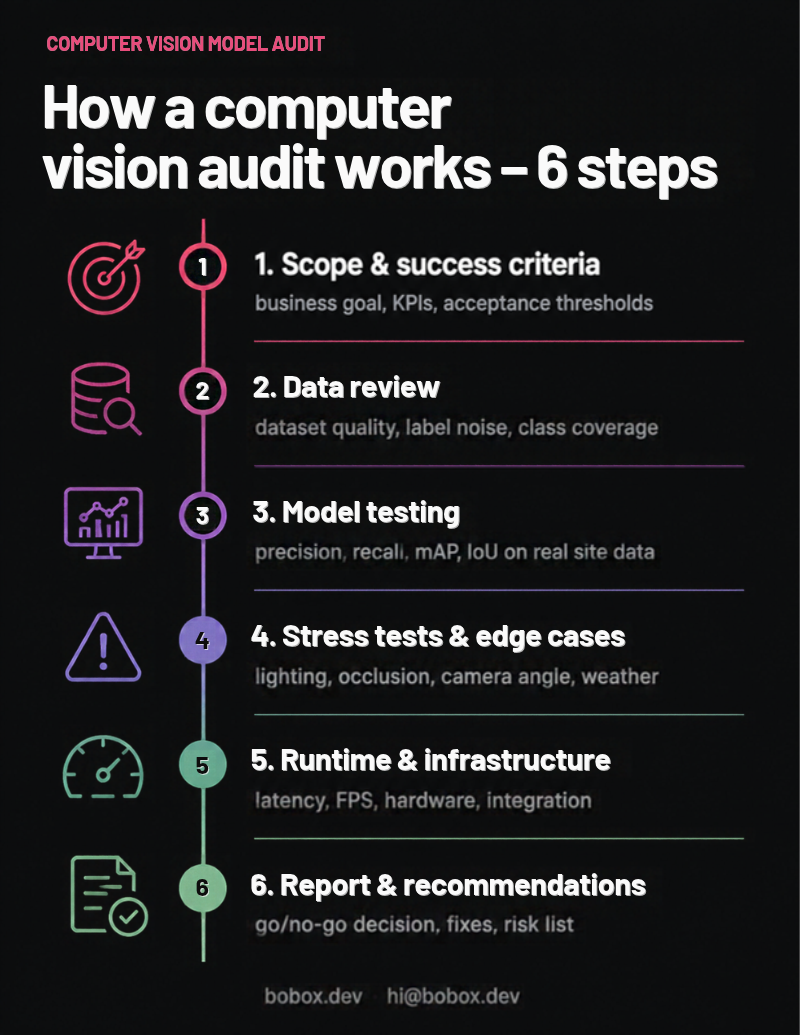
A typical audit takes 2–4 weeks, depending on scope and data access.
| Metric | What it tells you | Why it matters for the business |
|---|---|---|
| Precision | How many detections are correct | False alarms and wasted manual review |
| Recall | How many real objects the model finds | Missed defects, incidents or events |
| mAP | Overall detection quality across classes | One number to compare models or vendors |
| IoU | How well boxes or masks fit the object | Accuracy of counting, measuring, tracking |
| Latency / FPS | How fast the system responds | Real-time alerts and hardware cost |
| Accuracy per condition | Results split by lighting, camera, site | Shows exactly where the model breaks |
A good audit never reports one average number. It shows results per class, per site and per condition.
BoBox is a computer vision company from Poland. We specialize in data annotation, data validation and ML engineering, from proof of concept to production.
Validating AI takes more than machine learning knowledge. It takes hands-on experience with camera selection, lighting, compute infrastructure and system integration – the factors lab tests usually miss. We have annotated over 135,000 bounding boxes and delivered 954 hours of data validation in real projects.
That is why our reports include not only scores, but practical fixes that reduce deployment risk and improve return on investment.
Typically 2–4 weeks, depending on the number of models, sites and how quickly test data is available.
Yes. Independent acceptance testing of third-party systems is one of the main reasons companies order an audit.
Not always. We can evaluate a model as a black box, using its outputs on test data from your site. Access to the model gives deeper root-cause analysis.
Representative images or video from the target environment, covering normal and difficult conditions. If you do not have labeled test data, we can prepare it.
Training validation uses held-out data from the same source as the training set. An audit tests the model independently, on real operating conditions and edge cases.
Manufacturing and quality inspection, logistics, retail, and safety monitoring – anywhere a vision system drives an operational decision.

Planning a rollout or accepting a vision system from a vendor? Write to hi@bobox.dev or contact our team. We will suggest the audit scope in one call.
See all our computer vision services.
We use cookies to improve your experience on our site. By using our site, you consent to cookies.
Manage your cookie preferences below:
Essential cookies enable basic functions and are necessary for the proper function of the website.
These cookies are needed for adding comments on this website.
Statistics cookies collect information anonymously. This information helps us understand how visitors use our website.
Google Analytics is a powerful tool that tracks and analyzes website traffic for informed marketing decisions.
Service URL: policies.google.com (opens in a new window)
Clarity is a web analytics service that tracks and reports website traffic.
Service URL: clarity.microsoft.com (opens in a new window)
You can find more information in our Home and .