Modern retail operations increasingly adopt technological solutions to meet operational objectives efficiently. Computer vision offers two particularly high-value applications: customer journey analysis and merchandising optimization.
Customer Journey Analysis via Heatmaps
What are Store Heatmaps?
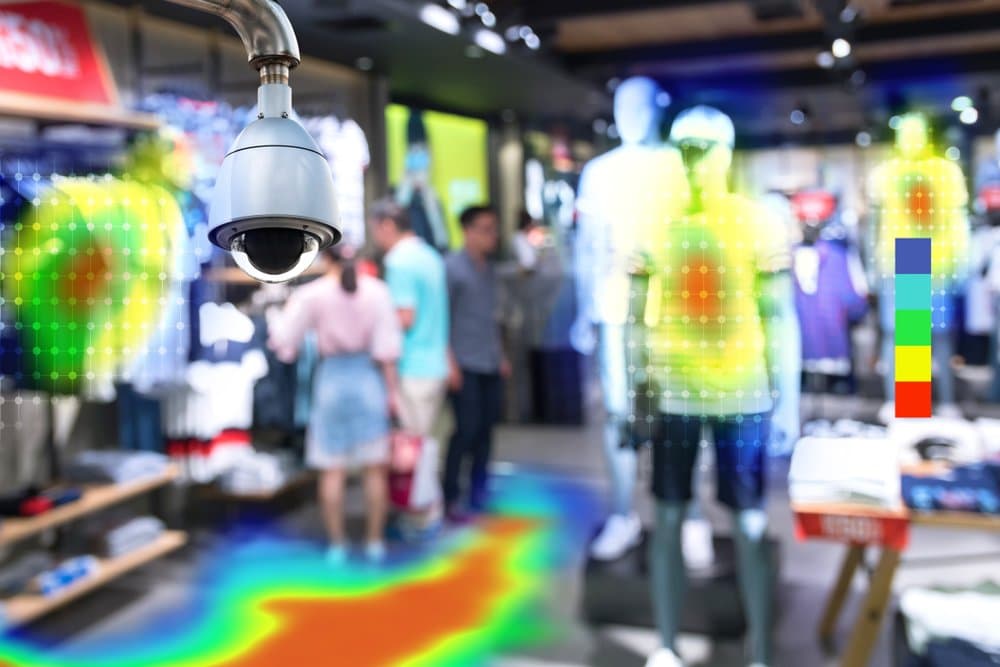
Store heatmaps visualize customer traffic patterns using color-coded overlays. Cool colors (blue-green) indicate lesser-visited areas, while warm colors (orange-red) show popular zones. This enables managers to identify high-traffic routes and neglected regions with objective data.
Technical Requirements
Heatmap generation relies on people detection algorithms that:
- Identify individuals in camera footage using bounding boxes
- Aggregate position data across multiple frames over defined time periods
- Convert detection frequencies into color-intensity visualizations
- Filter staff movement from customer movement
Practical Applications
Heatmap insights support:
- Marketing planning — identifying optimal locations for promotional displays and featured products
- Shelf arrangement optimization — placing high-margin products in naturally high-traffic areas
- Store design improvements — identifying and eliminating dead zones that customers avoid
- Temporal behavior analysis — comparing traffic patterns across different times of day, days of week, and seasons
- Staff allocation decisions — deploying associates where customer density is highest
Quality Considerations
Reliability depends on detection algorithm accuracy calibrated for your specific store environment. Two critical error types affect results:
- False positives create artificial "hot spots" — overinflating the apparent popularity of areas
- False negatives bias regions artificially "cold" — making popular areas appear less visited
Merchandising Applications
Real-World Implementations
Computer vision merchandising solutions are deployed by major retailers including Amazon Go stores and Żabka convenience stores in Poland, enabling seamless shopping experiences through shelf-based product identification without checkout lines.
Key Merchandising Capabilities
Planogram Compliance Monitoring — Computer vision systems verify product placement compliance against established layout schematics using employee-captured photos or fixed cameras. Out-of-place products are flagged automatically for correction.
Real-Time Inventory Monitoring — Automated product identification enables live stock-level monitoring and staff notifications for restocking requirements. Particularly valuable in large-format stores where manual shelf checking is time-prohibitive.
Shelf Heatmaps and Behavior Analysis — Combined people and product recognition algorithms measure customer interaction patterns with specific products, generating data for enhanced planogram development.
Benefits Summary
Computer vision delivers:
- Significant time and cost savings over manual monitoring
- New analytical data on operations and customer behavior
- Affordable infrastructure using standard market cameras
Data Annotation for Retail Computer Vision
Successful retail CV implementation requires well-prepared training data:
- Data collection method — cameras vs. employee-captured photos at standardized angles
- Annotation methodology — bounding boxes for product detection; semantic segmentation for shelf analysis
- Training dataset diversity — multiple product arrangements, shelf sizes, and lighting conditions
- Validation against production data — performance must be verified in real store environments, not just test sets