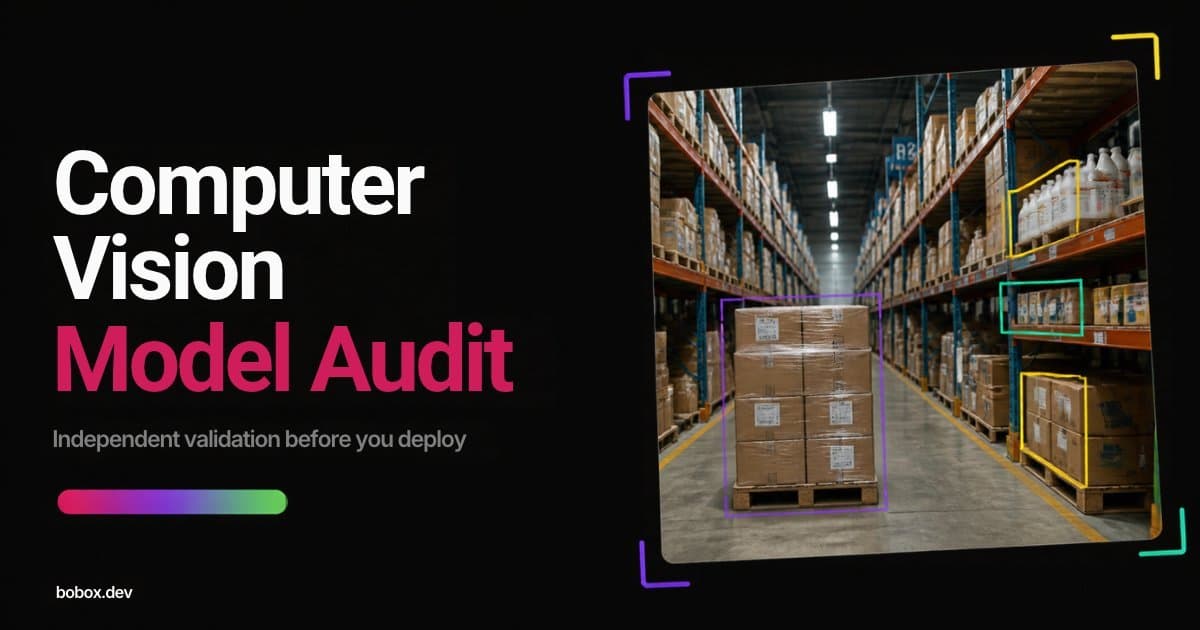
Computer vision represents a rapidly expanding technology with diverse applications across industries. The technology promises automation, cost reduction, and product enhancement, yet implementation involves significant complexities — from algorithm development through hardware configuration to ongoing maintenance.
Many projects fail to reach production or exceed budgeted timelines without demonstrating ROI. Common pitfalls include overly complex scopes, unreliable data, and unmeasurable objectives.
BoBox has established best practices derived from multiple computer vision implementations, creating standards for project definition, execution, monitoring, and deployment.
1. Scope Definition
Clear business understanding with measurable outcomes proves essential before writing a single line of code.
Key considerations include:
- Expected operational environment and conditions (indoor/outdoor, lighting, weather)
- Hardware specifications (camera type, resolution, processing power)
- Legal aspects regarding data ownership and availability
A well-defined scope prevents scope creep and ensures resources are allocated appropriately throughout the project lifecycle.
2. Computer Vision Component Design
Teams must understand typical CV techniques to select appropriate algorithms. This encompasses:
- CV methodology selection — object detection, segmentation, keypoint detection, classification
- Feature recognition specifications — what exactly should the model detect and with what precision
- Training dataset standards — quality requirements, diversity needs, minimum dataset size
- Model output and post-processing requirements — confidence thresholds, non-maximum suppression, downstream integration
3. Dataset Collection
High-quality datasets prove critical to success. Requirements include:
- Careful data selection and quality control from the start
- Early sample acquisition for annotation guideline development
- Representative coverage of edge cases and rare scenarios
- Consistent annotation rules enforced across all annotators
4. Data Annotation
Human-powered annotation demands significant time and directly impacts model performance. Recommendations:
- Build well-trained annotation teams with established quality revision processes
- Plan for multiple iteration cycles — annotation quality improves with reviewer feedback
- Don't underestimate time requirements — annotation is typically 40–60% of total project effort
- Consider outsourcing to specialized annotation partners for scale or specialized domain knowledge
5. Model Training, Evaluation, and Iteration
The iterative ML workflow:
- Test multiple models and compare results against your specific dataset
- Establish evaluation metrics relevant to business outcomes (not just mAP)
- Expand datasets based on observed model failures and biases
- Test early in the business environment — not just on held-out test sets
- Plan for post-deployment monitoring and model maintenance
Conclusion
Computer vision offers transformative potential, yet success requires adherence to proven methodologies spanning scope definition through ongoing evaluation. Organizations implementing these practices can effectively harness CV technology for innovation and efficiency gains.
The most common failure mode is treating data preparation as an afterthought. Build annotation quality and dataset rigor into your project plan from day one — and consider partnering with experienced annotation specialists to accelerate this phase.