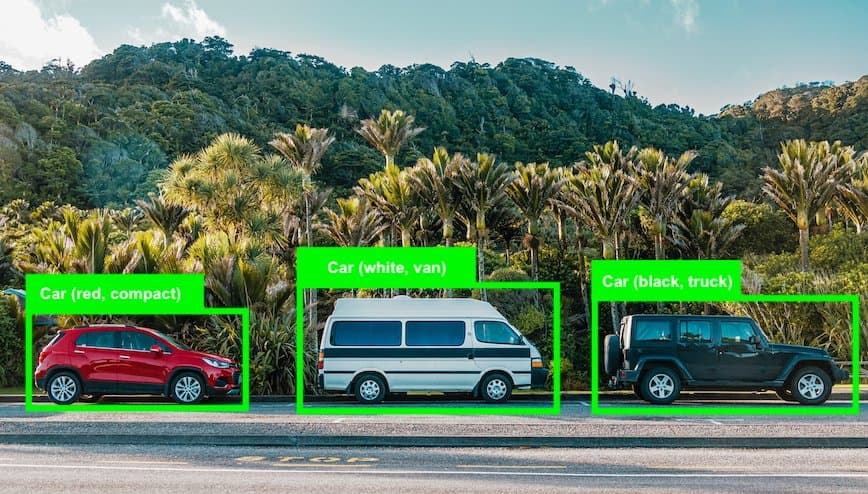
The ability to recognize vehicles and track their motion patterns opens a variety of applications in transportation, security, and logistics. Vehicle detection allows not only simple detection of objects in a given area, but also ensures a level of certainty that the detected object is indeed a specific type of vehicle.
Traffic Management and Control Systems
Traffic optimization represents a major urban challenge as vehicle volumes increase and road infrastructure remains constrained. Street cameras with computer vision provide significant advantages over traditional inductive loop sensors:
- Detection of approaching vehicles at greater distance, enabling proactive signal management
- Synchronized data collection across intersections for city-wide optimization strategies
- Anomaly detection (wrong-way driving, stalled vehicles, accidents) for rapid response
Speed Control and Toll Systems
Section control systems measure vehicle speed between two checkpoints, calculating average speed over distance. This approach is more difficult to defeat than point-speed cameras and requires proper vehicle re-identification across sensor points.
Automated toll collection reads license plates for hands-free highway, garage, and airport access billing. OCR-equipped camera systems match plates to vehicle databases in real-time, processing vehicles at highway speeds without stopping.
Parking Management
Intelligent parking systems use computer vision to:
- Detect unoccupied parking spots in real-time
- Direct drivers to available spaces through dynamic signage
- Monitor parking duration for enforcement applications
- Provide utilization analytics for facility planning
Drive-Through Operations
Fast-service restaurants and other drive-through operations benefit from computer vision by:
- Measuring service speed and wait times at each station
- Alerting operators when vehicles have exceeded expected service times
- Tracking throughput and peak-hour patterns for staffing optimization
- Identifying vehicle types for pre-populated order suggestions
Building Vehicle Detection Datasets
Training accurate vehicle detection models requires diverse, well-annotated datasets covering:
- Multiple vehicle types (cars, trucks, motorcycles, bicycles, emergency vehicles)
- Various viewpoints (overhead, side, front, rear, angled)
- All lighting conditions (day, night, twilight, artificial lighting)
- Weather conditions (rain, snow, fog, glare)
- Occlusion scenarios (partially hidden vehicles, vehicle clusters)
Annotation approaches include bounding boxes for basic detection, tracking IDs for multi-frame consistency, and license plate crops for OCR training datasets.