Fast and accurate quality control remains essential in mass production. Computer vision can be extremely helpful in detecting quality anomalies, as it enables the automation of quality control processes.
Computer Vision in Wood Flooring Quality Control
The wood-based industry produces billions of products annually. Computer vision accelerates anomaly detection through automated inspection, yielding faster, more accurate, and more consistent outcomes compared to manual methods. This approach reduces defects reaching customers and lowers the cost of inspection.
By analyzing wood flooring images, algorithms identify quality anomalies — knots, cracks, color variations, surface irregularities — that manual inspection might overlook, improving accuracy and efficiency while reducing inspection costs.
How to Enable Computer Vision for Quality Control
A step-by-step implementation approach:
- Prepare the data — Collect varied quality images covering both acceptable and unacceptable samples across the full range of defect types
- Pre-processing — Convert to grayscale or resize images; apply normalization for computational efficiency
- Feature extraction — Identify anomalies using edge detection, blob detection, or texture analysis
- Anomaly detection — Apply background subtraction, change detection, or object detection techniques
- Classification — Train ML models (SVM or CNN) on annotated data to distinguish acceptable from defective
- Validation — Evaluate model performance against ground-truth annotations from production data
Model effectiveness depends directly on annotation quality and quantity — particularly the representation of rare defect types in the training data.
Data Annotation Importance
Data annotation is extremely important in computer vision for quality control. Proper annotation:
- Ensures training data reflects real-world manufacturing scenarios
- Mitigates overfitting by representing the full variance of production conditions
- Reduces bias by including edge cases and borderline-acceptable samples
- Improves accuracy by clearly defining what constitutes a defect vs. acceptable variation
Annotation workflow for manufacturing quality classification:
- Define quality exceptions for your product (cracks, knots, stains, dimensional deviations)
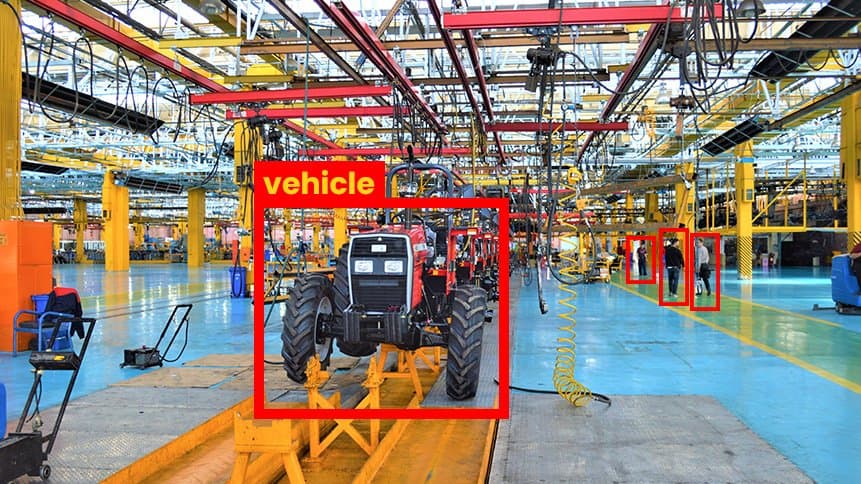
- Create bounding boxes or segmentation masks around exceptions
- Verify annotation accuracy through multi-reviewer cross-checking
- Split data into training and validation sets
- Train model using annotated images and iterate based on performance gaps
ML Models vs. OpenCV Library
Two approaches address quality control automation:
Machine Learning approach — CNNs or SVMs trained on annotated defect datasets, capable of detecting complex, subtle defects and generalizing across product variations.
OpenCV framework — Image processing functions for deterministic inspection. A typical processing pipeline:
- Capture high-resolution images in real-time
- Apply Gaussian blur to reduce noise
- Threshold images to isolate anomalies
- Detect contours using
cv2.findContours() - Measure anomaly size via
cv2.contourArea() - Classify anomalies using SVM or KNN algorithms
The OpenCV approach works well for simple, well-defined defects. ML approaches handle complex, variable defects with better generalization.
Summary
Computer vision automates inspection and ensures quality standards compliance regardless of production speed. Data annotation is a crucial step in this process — it transforms raw production imagery into labeled training data that teaches the model to recognize acceptable from defective.
High-quality annotated datasets are the foundation of accurate machine learning quality control systems. BoBox's data annotation experts provide representative, diverse examples while ensuring annotation consistency and accuracy across large-scale quality control datasets.