Agriculture & Livestock
Agricultural ground truth that knows a weed from a seedling.
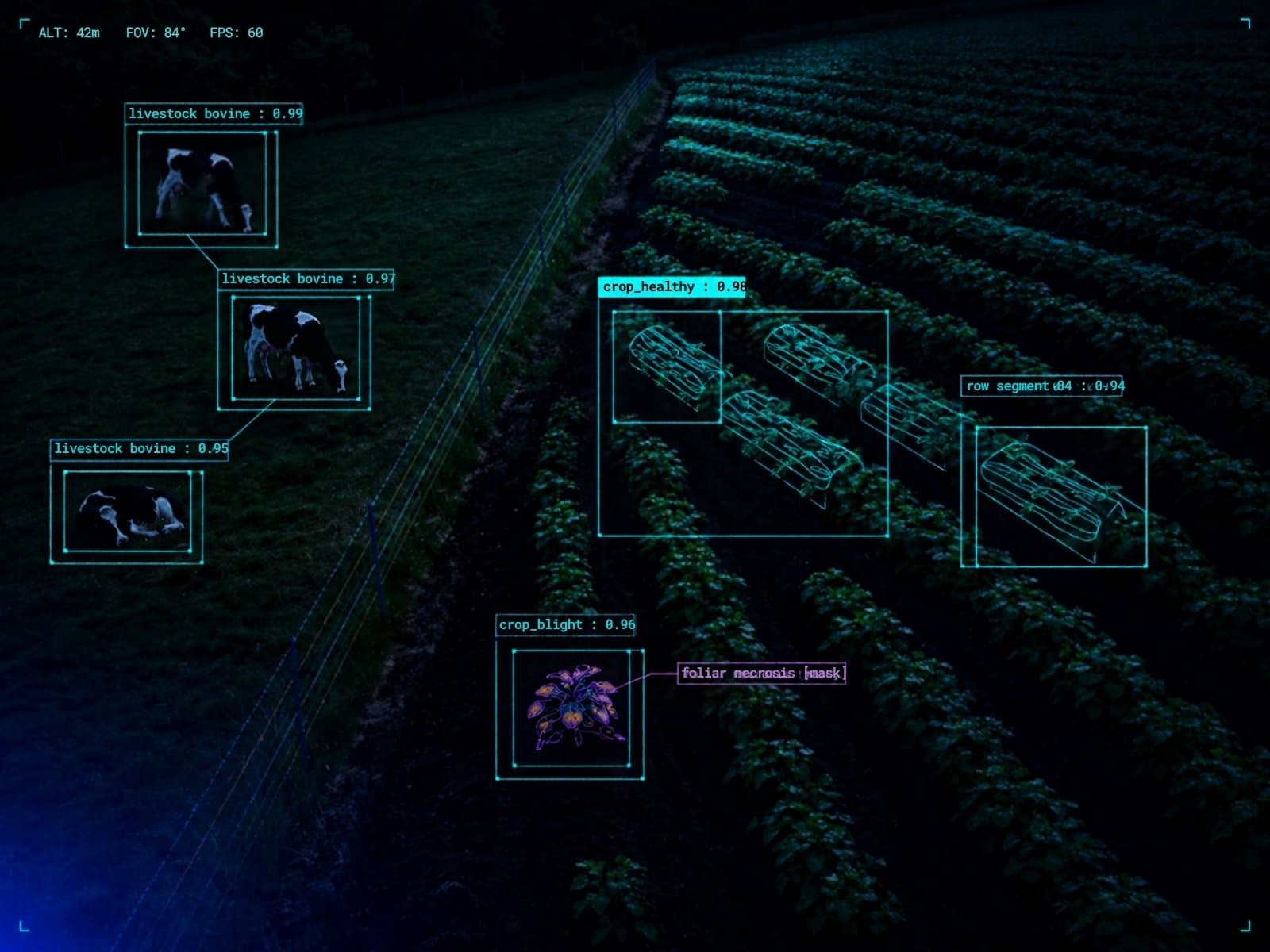
Precision farming models need labels that only domain-aware annotators get right: early disease symptoms, crop varieties, pests and animal behaviour. We annotate drone, field-camera and barn footage across seasons and growth stages, including unusual domains like fish farming.
The hard part
Why agriculture data is hard to label.
Where generic annotation vendors usually lose accuracy — and where a senior team makes the difference.
- Irregular shapes — disease patches, weeds and canopies — that need segmentation, not boxes.
- Strong variation across seasons, weather, growth stages and camera angles.
- Class labels that require agricultural knowledge: crop varieties, disease types, pest species.
- Individual animals in dense herds, and subtle behavioural signs of illness.
Use cases
What we annotate for agriculture.
Disease & pest detection
Early identification of fungal infections, pests and nutrient deficiencies for targeted treatment.
Yield estimation
Crop and fruit counting to forecast harvest volumes and plan logistics weeks ahead.
Harvest automation
Ripeness detection and object recognition for picking robots and harvest timing.
Plant phenotyping
Automated measurement of growth parameters across thousands of plants for breeding programmes.
Livestock health & counting
Animal detection, counting and abnormal-behaviour monitoring in barns and on pasture.
Aquaculture
Fish detection and feeding-behaviour analysis to improve health and reduce over-feeding.
Annotation types
- Segmentation masks for disease patches and weeds
- Bounding boxes for fruits, animals and pests
- Keypoints for animal posture
- Multispectral and drone imagery labeling
How we work
Taxonomy and edge-case guidelines agreed with your team before production, multi-pass QA with inter-annotator agreement, and a 98%+ QA pass rate. All data processed in the EU.
FAQ
Agriculture questions, answered.
Do your annotators understand agronomy?
A senior taxonomy lead works with your agronomists to define classes and edge-case rules up front, so annotators label disease stages and varieties consistently.
Can you work with drone and multispectral imagery?
Yes. We annotate aerial RGB as well as multispectral imagery, using segmentation for irregular shapes and boxes for countable objects.
Do you annotate livestock and fish?
Yes. Animal detection, counting and behaviour labels for barns, pastures and fish farms are exactly the niche domains we take on.
Further reading
From the BoBox blog.
Areas of Application of Computer Vision in Agriculture (Part 1)
By leveraging computer vision technologies in crop planning, farmers can make data-driven decisions, optimize resource usage, and enhance sustainability.
Areas of Application of Computer Vision in Agriculture (Part 2)
Smart computer vision algorithms are transforming modern livestock farming and agriculture — from precision animal health monitoring to aquaculture optimization.
Harnessing AI/ML for Advanced Geospatial Image Processing
Satellite and aerial imagery annotation at scale — how AI/ML transforms geospatial data into actionable intelligence for environmental monitoring, agriculture, and urban planning.
Have agriculture data that needs senior eyes?
Tell us about your dataset, model and timeline. A senior team member will reply.