Manufacturing & Industrial Inspection
Defect labels your quality team would sign off on.
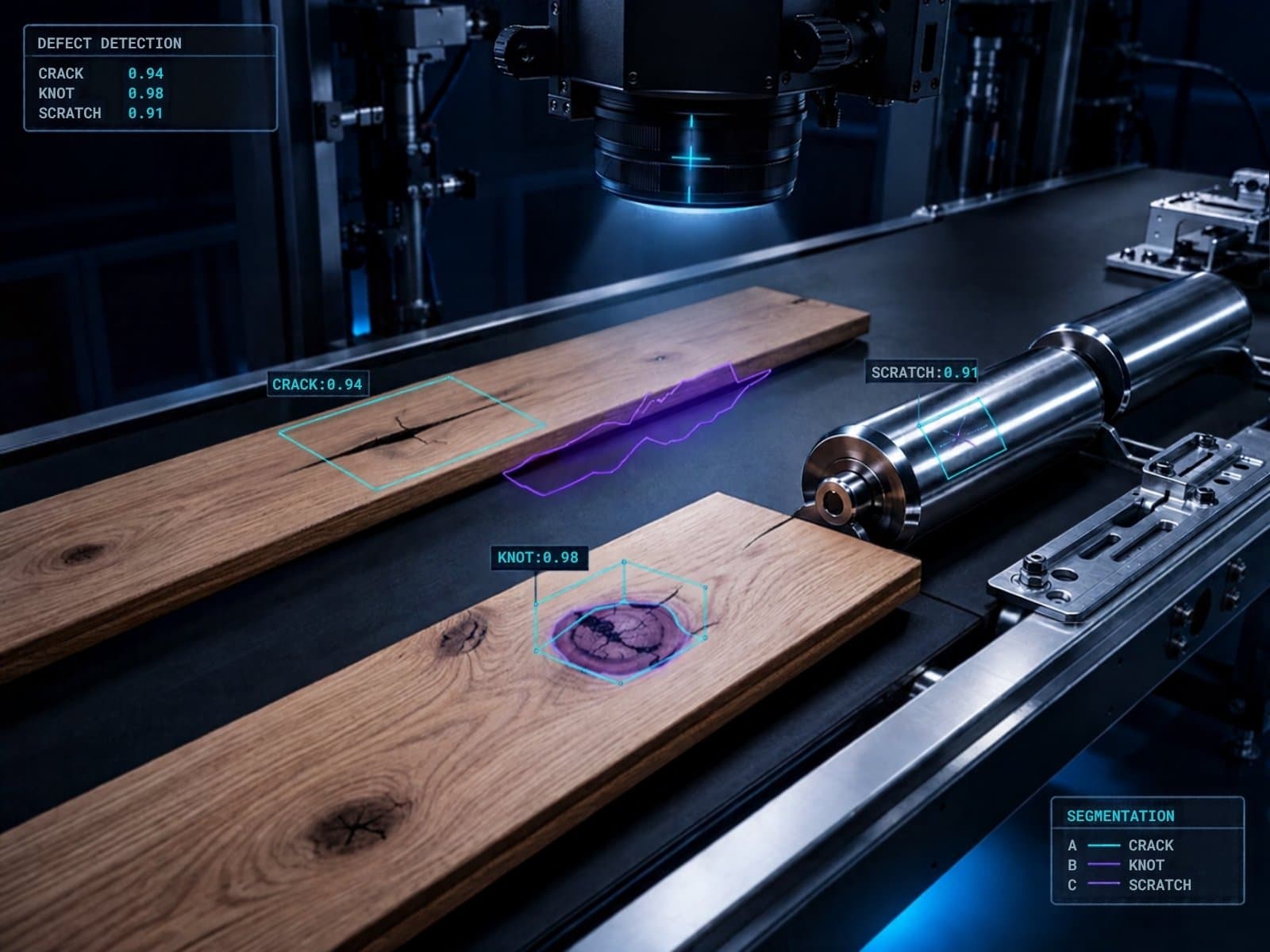
Industrial inspection models fail on the defects nobody labelled: rare cracks, borderline colour variation, a new material batch. We define what counts as a defect together with your quality team and annotate production imagery so the rare cases are actually represented.
The hard part
Why manufacturing data is hard to label.
Where generic annotation vendors usually lose accuracy — and where a senior team makes the difference.
- Rare defect types that are underrepresented in production data.
- Borderline cases where acceptable variation and defects look alike.
- High-speed lines with motion blur, reflections and changing materials.
- Endless shape, colour and degradation combinations in waste and recycling streams.
Use cases
What we annotate for manufacturing.
Visual quality control
Detection of cracks, knots, stains, colour and surface defects — e.g. in wood flooring.
Production supervision
Multi-station monitoring and anomaly flagging integrated with line control.
Robot guidance
Object recognition and pose for picking, assembly and placement tasks.
Workplace safety
PPE and restricted-zone monitoring in hazardous production areas.
Warehouse inventory
Item identification and stock counting without barcodes, including drone counts.
Waste sorting
Material classification (plastic, metal, paper, glass, organics) for robotic sorting.
Annotation types
- Bounding boxes and masks around defects
- Image-level pass/fail classification
- Keypoints for robot grasping
- Multi-reviewer cross-checking
How we work
Taxonomy and edge-case guidelines agreed with your team before production, multi-pass QA with inter-annotator agreement, and a 98%+ QA pass rate. All data processed in the EU.
FAQ
Manufacturing questions, answered.
How do you define what counts as a defect?
We write the defect taxonomy and visual guidelines with your quality team before annotation, including borderline examples, so labels match your acceptance criteria.
What if our defects are very rare?
We help you collect and balance the dataset so rare defect types are represented, and flag coverage gaps during the data audit.
Do you also support recycling and waste sorting?
Yes. We annotate material categories from real facility cameras and refine guidelines iteratively against the edge cases a sorting line produces.
Further reading
From the BoBox blog.
How Computer Vision Improves the Quality Control Process
Quality control is extremely important in the mass production process. Computer vision enables automation that is faster, more accurate, and more consistent than manual inspection.
Areas of Application for Computer Vision Algorithms (Part 1)
Computer vision in industrial operations — from production supervising and quality control to workplace safety monitoring and inventory management.
How Can Computer Vision Move the World Economy Toward Zero Waste?
Waste management is one of the biggest challenges of the urban world. Computer vision-powered sorting robots and smart bins can transform the circular economy.
Have manufacturing data that needs senior eyes?
Tell us about your dataset, model and timeline. A senior team member will reply.