Retail & QSR
Retail models that work in your stores, not just in the lab.
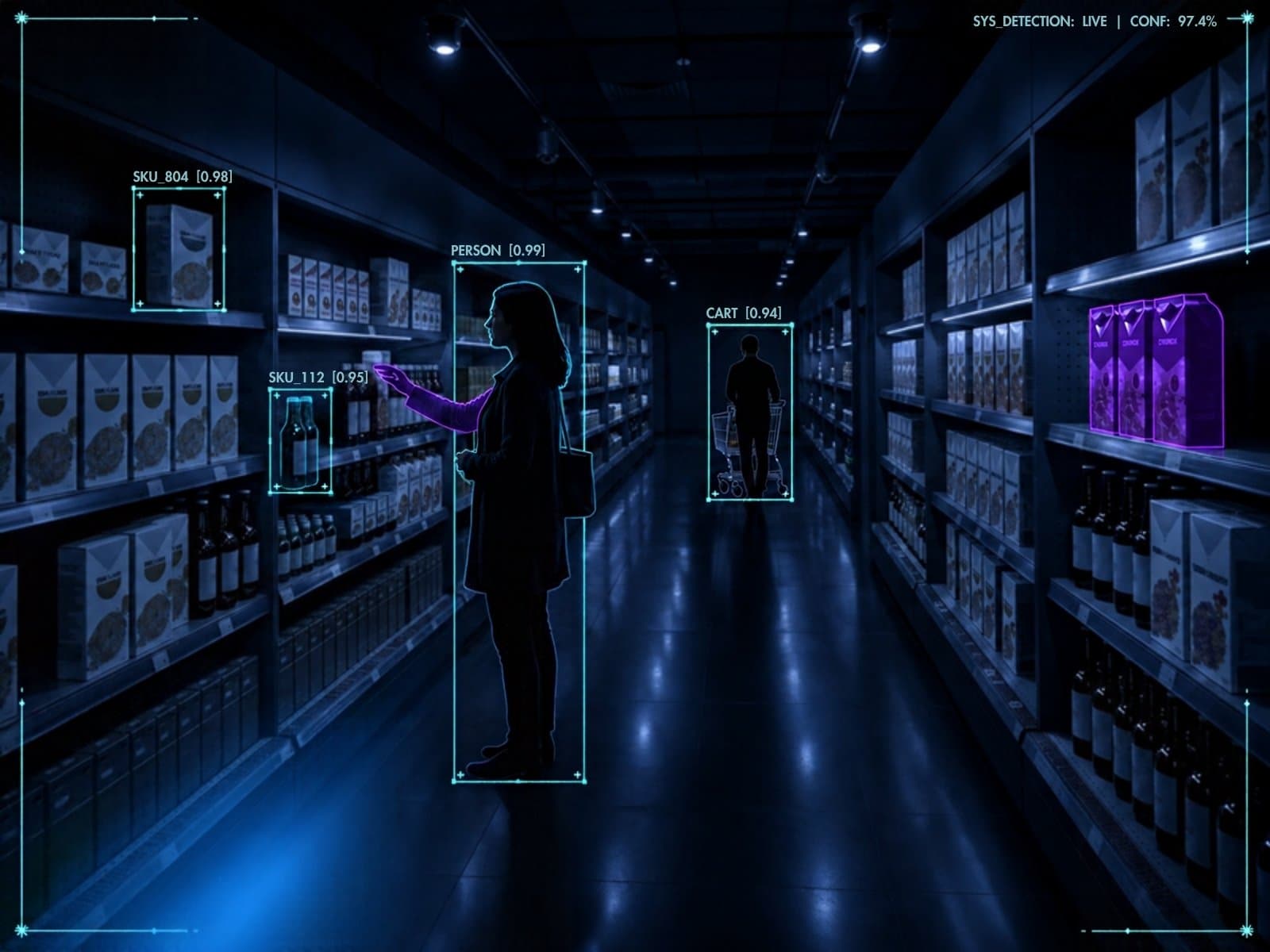
Retail computer vision lives or dies on edge cases: cluttered shelves, near-identical packaging, glare from fridge doors and crowds at the entrance. We build training data from your real camera angles and store layouts, so detection holds up after rollout.
The hard part
Why retail data is hard to label.
Where generic annotation vendors usually lose accuracy — and where a senior team makes the difference.
- Thousands of visually similar SKUs that differ only by flavour, size or label detail.
- Changing lighting, reflections and occlusions from shoppers, carts and staff.
- False positives that create fake hot spots in heatmaps, and false negatives that hide busy zones.
- Separating staff movement from customer movement in people analytics.
Use cases
What we annotate for retail.
Planogram compliance
Detect out-of-place and missing products against the agreed shelf layout, from fixed cameras or staff photos.
Real-time inventory
Product recognition for live stock levels and restocking alerts in large-format stores.
Customer heatmaps
People detection aggregated over time to reveal popular routes, dead zones and bottlenecks.
People counting & dwell time
Entry/exit counts, occupancy, queue and service timers — more precise than beam-break sensors.
Drive-through analytics
Vehicle detection and tracking to measure service time per station and peak-hour throughput.
Food detection for QSR
Item-level recognition for quick-service restaurant operations and order accuracy.
Annotation types
- Bounding boxes for products and people
- Semantic segmentation for shelf analysis
- Tracking IDs across frames
- SKU-level classification taxonomies
How we work
Taxonomy and edge-case guidelines agreed with your team before production, multi-pass QA with inter-annotator agreement, and a 98%+ QA pass rate. All data processed in the EU.
FAQ
Retail questions, answered.
How do you handle thousands of similar-looking products?
We design the SKU taxonomy with you before production — including rules for packaging variants, partially visible items and promotional labels — and validate every batch against it.
Can you annotate footage from our existing store cameras?
Yes. We prefer it: datasets built from your real camera angles, lighting and layouts are what make retail models reliable in production, not only on test sets.
Is shopper footage handled in line with GDPR?
Yes. Data is processed in the EU under GDPR, and we can anonymize faces and other personal data before or after annotation.
Further reading
From the BoBox blog.
Areas of Application of Computer Vision in Retail Stores
Retail stores apply new technologies to achieve operational goals more efficiently. From customer journey heatmaps to automated inventory management — computer vision in retail.
Areas of Application for Computer Vision Algorithms (Part 2)
Analyzing human traffic, customer counting, speed of service measurement, and heatmap visualization — advanced computer vision applications for people analytics.
Computer Vision for Vehicle Detection
Vehicle detection enables counting, tracking, and behavioral analysis. From traffic management to toll systems and drive-through operations — how CV powers smart transportation infrastructure.
Have retail data that needs senior eyes?
Tell us about your dataset, model and timeline. A senior team member will reply.